Top Custom O Ring Kit Manufacturers for Global Buyers
Choosing a reliable Custom O-Ring Kit Manufacturer requires more than comparing prices or catalog sizes. Global buyers need evidence of material control, production experience, and consistent inspection practices. A suitable supplier should understand sealing requirements across machinery, hydraulics, automotive systems, and maintenance applications. Details matter.
This guide introduces leading manufacturers that serve international customers with customized O-ring kits. It considers elastomer options, temperature resistance, chemical compatibility, hardness ranges, dimensional accuracy, and packaging quality. A practical kit may contain hundreds of rings, clearly labeled by size and material. Traceable batch records, inspection reports, and responsive technical support also deserve close attention. These details can reduce downtime when a replacement is needed quickly.
No supplier is ideal for every application. That is worth remembering. Some manufacturers excel at rapid sampling, while others offer stronger engineering support or larger production capacity. A low quotation may hide longer lead times, limited documentation, or weak communication. Buyers should compare actual test data, customization limits, delivery performance, and after-sales service before making a decision. This overview is designed to support that process with a balanced, experience-based perspective. It does not treat popularity as proof of quality. Instead, it focuses on practical indicators that can be checked, discussed, and verified with suppliers. A careful shortlist often starts with clear drawings, operating conditions, and realistic performance expectations. Fit comes first.
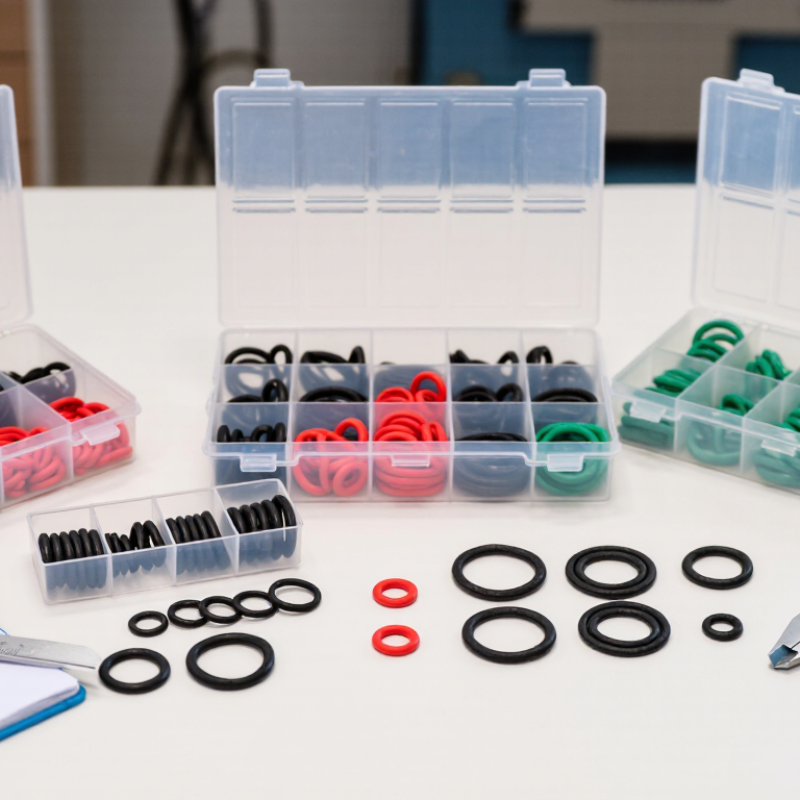
What Custom O-Ring Kits Are and Why Global Buyers Use Them
A custom O-ring kit contains sealing rings selected for a specific machine, fluid, temperature range, and maintenance plan. Sizes, cross-sections, materials, hardness levels, and quantities are matched to actual equipment requirements. The kit may also include identification labels, storage guidance, and lot traceability. It is more than a box of spare parts. A well-designed kit reduces guesswork during repairs and helps technicians avoid fitting an unsuitable seal.
Global buyers use these kits because equipment often operates across different climates, facilities, and service schedules. A food-processing line may need compliant elastomers, while hydraulic equipment may require resistance to oil, pressure, and temperature changes. Buyers also value organized packaging when parts must travel between warehouses or remote sites. Clear documentation supports purchasing teams, technicians, and quality auditors. Small details matter. One missing size can delay an entire repair.
Reliable manufacturers usually review drawings, sample parts, operating conditions, and media compatibility before production. They should explain material choices, inspection methods, compression-set testing, and batch traceability. Buyers can request samples before approving larger orders. This step is practical, but it is sometimes skipped. A kit can look complete and still contain an incorrect hardness or profile. That weakness is easy to overlook. Careful suppliers ask questions, record revisions, and inspect dimensions consistently, although no process removes every possibility of human error.
Key Criteria for Evaluating Custom O-Ring Kit Manufacturers
Choosing a custom O-ring kit manufacturer requires more than comparing unit prices. Practical experience starts with understanding the sealing environment: temperature, pressure, fluid exposure, motion, and storage time. A capable supplier should recommend suitable elastomer grades, not simply offer the most common material.
Material traceability is essential. Ask for batch records, compound identification, inspection reports, and clearly stated dimensional tolerances. The manufacturer should explain testing for hardness, tensile strength, elongation, compression set, and leakage resistance. Samples matter. However, a successful sample does not always guarantee stable mass production.
Look closely at customization control. Can the supplier produce unusual sizes, mixed kits, labeled compartments, and protective packaging? Clear drawings and approval samples reduce costly misunderstandings. Communication matters too. Technical replies should address your operating conditions with evidence, not vague promises. A reliable manufacturer also maintains consistent inspection procedures and explains how nonconforming parts are handled. Small details count. I have seen attractive kits fail because labels faded, bags absorbed moisture, or sizes were mixed during packing. That is why production records, final inspection photos, and shipment checks deserve attention. One weakness remains easy to overlook: some suppliers document materials well but provide limited field feedback. Buyers should ask for relevant application experience and review the evidence carefully.
Leading Manufacturer Capabilities and Product Customization Options
Global buyers increasingly seek O-ring kit manufacturers with measurable engineering depth, not only large catalogs. Grand View Research reported that the global O-ring seals market was valued at approximately USD 14.6 billion in 2023, with continued growth expected through 2030. This expansion raises quality expectations. Capable manufacturers should offer compound selection for temperature, pressure, chemicals, and media exposure. They should also control mold design, mixing, molding, trimming, and final inspection. ISO 3601 dimensional verification, ASTM D2000 material classification, hardness testing, tensile testing, and compression-set analysis provide useful evidence of process control.
Customization should begin with the application, not a preferred material. A hydraulic kit may require different sealing compounds than a food-processing assembly. Custom kits can include metric and imperial sizes, color-coded compartments, batch labels, drawings, and traceable inspection records. Packaging matters too. A technician working beside a machine needs to find a 32-millimeter seal quickly, without opening ten identical bags. Manufacturers with in-house tooling can usually shorten development cycles and correct flash, shrinkage, or fit problems earlier. However, faster is not always better. A rushed prototype may pass a visual check but fail after heat aging or repeated compression. MarketsandMarkets identifies performance reliability and material compatibility as key factors in sealing-product selection. Buyers should request validation samples, shelf-life data, and lot-level certificates before approving production. Some customization requests look efficient but create unnecessary inventory risk. That deserves a second review.
Material, Certification, Quality Control, and Testing Requirements
Choosing top custom O-ring kit manufacturers requires more than comparing prices. Material control comes first. Common elastomers include NBR for oils, EPDM for water and steam, FKM for heat and chemicals, and silicone for wider temperature flexibility. A reliable manufacturer should provide compound identification, hardness, tensile strength, elongation, and compression-set data. ASTM D2000 classification helps buyers compare rubber performance consistently. ISO 3601 also defines critical dimensional and tolerance requirements for O-rings.
Certification claims need careful checking. The ISO Survey 2023 reported more than one million ISO 9001 certificates worldwide, but certification alone does not prove production quality. Ask for a valid certificate, scope, expiry date, and audit body. For food-contact applications, request evidence aligned with applicable FDA requirements or EU Regulation 1935/2004. For each batch, inspect dimensions, surface defects, hardness, and flash. Sample testing should include compression set, tensile properties, leakage, and aging at the intended temperature. A barcode-linked inspection report makes traceability practical.
Professional buyers should also request testing records from accredited laboratories when risk is high. ASTM D395 supports compression-set testing, while ASTM D1414 covers O-ring tensile and dimensional testing. Reports should identify the compound batch, test temperature, duration, and equipment calibration status. Some suppliers provide impressive documents but weak sampling plans. That gap deserves attention. A small pilot order, witnessed inspection, and retained samples can reveal problems before global shipment.
Custom O-Ring Kit Requirements for Global Buyers
Typical continuous service-temperature ranges for commonly specified O-ring materials. Final selection should be verified against the application medium, pressure, temperature cycling, and applicable standards.
Global buyers commonly request traceable material certificates, batch identification, dimensional inspection, visual defect inspection, hardness testing, compression-set testing, and documented quality systems such as ISO 9001. Depending on the application, additional requirements may include FDA 21 CFR 177.2600, EU food-contact compliance, ASTM or ISO test methods, and customer-specific validation.
How Global Buyers Can Compare Suppliers and Place Orders
Top Custom O Ring Kit Manufacturers for Global Buyers
Global buyers should compare suppliers beyond catalog prices. A reliable manufacturer should explain material grades, hardness ranges, temperature limits, and sealing applications clearly. Request drawings, tolerance data, batch traceability, and recent inspection reports. These documents show whether the supplier controls production consistently.
Ask for samples that match your actual operating conditions. Test fit, compression, chemical resistance, and recovery before placing a large order. Compare minimum order quantities, production lead times, packaging, payment terms, and shipping responsibilities. A supplier may offer a lower unit price but create higher costs through damaged packaging or inconsistent sizing. Confirm the exact kit contents in writing. Small details matter.
Tips: Build a simple comparison table. Include price, sample results, certifications, response time, and after-sales support. Contact at least three manufacturers. Keep communication records. If answers remain vague, pause the order. A factory visit or independent inspection can reduce uncertainty, although it adds cost. It is also wise to approve a pre-production sample before mass manufacturing. I have found that buyers often focus too heavily on price. That approach can fail when one missing ring delays an entire maintenance job. Supplier comparison is not perfect, but careful evidence makes the decision more dependable.